
Choosing the most suitable lever handle manufacturing process is essential for achieving the durability, appearance, cost efficiency, and functional performance expected in modern architectural and furniture hardware. Lever handles are used in residential, commercial, and industrial environments, meaning their structural integrity and finish quality directly influence user experience and safety. This article explains the major manufacturing processes, compares their strengths, and highlights how selecting high-quality stainless-steel lever handles—such as those produced by DESCOO—ensures long-term reliability. For additional reference on professionally engineered products, you may explore our stainless-steel collections through our lever handle series.
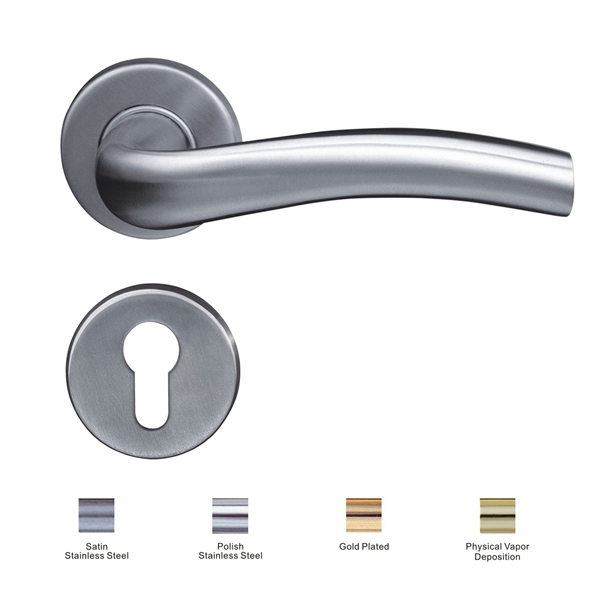
Lever handles must withstand frequent use, resist corrosion, maintain smooth mechanical movement, and align with aesthetic design requirements. Because of this, manufacturers rely on different production processes depending on the design complexity, performance expectations, and project budget.
A well-designed lever handle is not only a decorative component but also a functional mechanism that must deliver stability under repetitive operation. DESCOO follows a strict quality management system, ensuring that every handle maintains dimensional accuracy, finish consistency, and long-term structural reliability.
Below is an overview of the most common production methods. The right process depends on your functional, structural, and design priorities.
Casting involves pouring molten metal into a mold that forms the general shape of the lever handle.
Characteristics:
Suitable for complex shapes and creative designs
Allows thick sections with strong structural support
Economical for medium to large runs
Performance evaluation:
When produced with precision molds, cast stainless steel handles achieve strong corrosion resistance and uniform surface quality after machining and polishing. DESCOO uses controlled casting parameters to maintain consistency and reduce internal defects.
Forging compresses metal under high pressure to form the handle shape. This process changes the internal grain structure, giving the material higher tensile strength.
Advantages:
Exceptional mechanical strength
Hard-wearing surface that resists deformation
Ideal for heavy-traffic applications such as commercial buildings, hotels, and public facilities
Usage note:
Forged lever handles are often preferred for premium projects where durability and long service life are critical.
CNC machining uses computer-controlled tools to shape metal into precise components with tight tolerances.
Why it is used:
Delivers the highest dimensional accuracy
Supports custom shapes and technical details
Ensures smooth edges and precise alignment for locksets
CNC machining is a core capability in DESCOO’s production line, helping ensure every lever handle fits lock bodies, spindles, and rosettes with superior accuracy.
This process cuts and forms metal sheets using stamping dies. It is typically used for escutcheons, plates, and base components rather than the main lever body.
Benefits:
Efficient for large-volume production
Stable dimensional repeatability
Cost-effective for standard designs
Some lever handles combine separately manufactured components that are welded or mechanically joined. Precision welding ensures seamless joints and optimal structural performance.
Key requirements:
Clean welding lines
High alignment accuracy
Post-polishing for surface uniformity
DESCOO applies controlled welding and polishing processes to ensure smooth visual transitions and strong mechanical rigidity.
Surface finishing affects appearance, corrosion resistance, and tactile texture. Different finishes match different architectural styles.
| Finish Type | Characteristics | Common Applications |
|---|---|---|
| Brushed / Satin | Subtle texture, hides fingerprints | Modern interiors, offices |
| Mirror Polish | High gloss, decorative | Luxury residences, hospitality |
| PVD Coating | Superior wear resistance | High-traffic buildings |
| Powder Coating | Color flexibility | Commercial and residential projects |
DESCOO’s lever handles undergo rigorous finishing control to ensure consistent color, adhesion, and surface smoothness.
High humidity or coastal environments
Choose stainless-steel forged or CNC-machined handles for maximum corrosion resistance.
High-traffic commercial facilities
Forged handles deliver the best durability under repeated use.
Decorative or artistic interior projects
Casting allows more complex and stylish designs.
If mechanical strength is the priority → Forging or CNC machining
If the project needs cost-effective options → Casting or stamping components
If long-term stability is essential → Choose stainless-steel material with high-precision assembly
DESCOO ensures every product meets international durability and performance standards.
For uniquely shaped lever handles or special design requests, CNC machining combined with custom polishing provides the highest flexibility.
Custom OEM/ODM requests can be supported through DESCOO’s engineering team and advanced equipment.
Economical: Stamping + casting
Mid-range: Casting with CNC refinement
High-end: Full CNC machining or forging
Each tier provides different performance benefits, and DESCOO offers solutions aligned with project value and durability needs.
Lever handles are used thousands of times over their lifespan. Low-quality production can lead to:
Loose joints
Corrosion spots
Misalignment with lock mechanisms
Shortened product life
DESCOO’s manufacturing practices eliminate these issues through:
CNC precision machining
Strict quality inspection
Multi-stage polishing
Corrosion-resistant stainless-steel materials
Stable OEM/ODM delivery schedules
Explore our durable, precision-engineered products at the DESCOO Lever Handle Collection.
To choose the right lever handle manufacturing process:
Forging → Maximum strength and durability
Casting → Flexibility for complex shapes
CNC machining → Highest precision for premium projects
Stamping → Efficient production of accessories and plates
Welding + Polishing → Clean structure and high-quality finishing
DESCOO integrates these techniques to produce stable, high-precision stainless-steel lever handles suitable for residential, commercial, and institutional applications.
The ideal manufacturing process depends on durability expectations, design preferences, functional needs, and project budget. Whether you need heavy-duty forged handles, decorative cast designs, or precisely machined stainless-steel components, DESCOO provides reliable solutions backed by professional engineering and strict quality control.
To explore premium stainless-steel lever handles built with advanced production methods, visit our lever handle product page.