
A lever handle looks simple from the outside, but a truly high-quality lever handle is the result of controlled manufacturing steps and repeated quality checks that protect performance in daily use. Buyers often judge appearance first, yet the real differentiators are hidden in the details: machining accuracy that keeps rotation smooth, assembly tolerances that prevent wobble, spring and spindle consistency that maintains return function, and surface finishing that resists wear in high-touch environments.
This article explains the key manufacturing steps and the quality checks that matter most when sourcing lever handles for doors in residential and commercial projects. We are DESCOO, and our lever handle range is available here: Lever Handle.
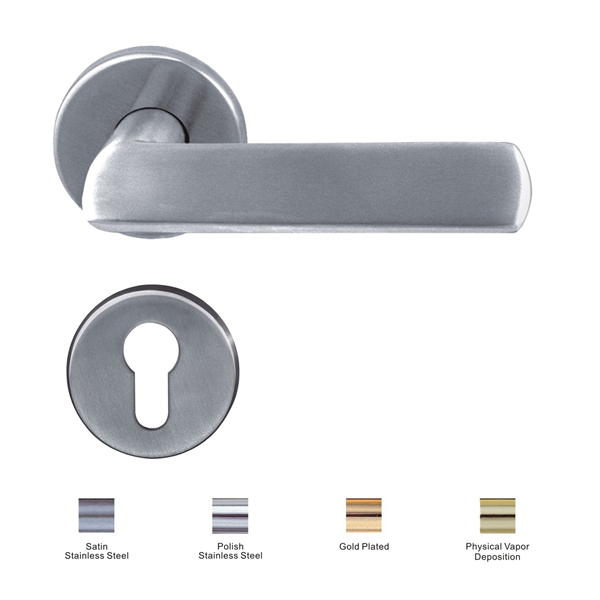
High-quality lever handles start with stable raw materials. The chosen base material influences strength, machining behavior, corrosion resistance, and finishing consistency. Common lever handle materials include stainless steel and zinc alloy, and each requires different process control. The most important supplier responsibility at this stage is to confirm that the incoming material matches the intended specification and is consistent batch to batch.
Chemical composition and grade verification
Material grade confirmation reduces risk of unexpected corrosion behavior or inconsistent hardness.
Mechanical property screening
Basic yield and tensile expectations should be stable so the handle does not deform under repeated force.
Surface condition and defect screening
Pitting, inclusions, or inconsistent casting quality lead to finishing defects later and reduce yield.
Traceability
Batch tracking supports problem isolation and ensures repeatability for long-term projects.
If the material stage is weak, no finishing upgrade can compensate for structural inconsistency.
Lever handle shaping differs depending on material and design. High-quality production focuses on dimensional control and surface readiness for finishing.
Precision casting for complex shapes
Casting supports detailed designs and is often used when decorative geometry is needed. The success factor is casting consistency and porosity control.
Forging for higher density structures
Forging improves structure density and can enhance durability, especially for high-use applications.
CNC machining from bar or blank
Machining delivers strong dimensional control and is often used for designs that require crisp lines and consistent geometry.
Control of critical dimensions such as handle thickness, neck geometry, and hub alignment
Prevention of deformation that creates off-center rotation after assembly
Avoidance of internal voids or shrink marks that later appear during polishing
A handle that looks fine before finishing can still fail quality if internal structure or geometry is unstable.
Machining is where a lever handle becomes functional rather than decorative. This stage defines how smoothly the handle rotates and how stable it feels on the door.
Spindle interface and square hole alignment
Misalignment causes binding, uneven rotation, and early wear on the spindle and springs.
Rose and mounting interface flatness
If the mounting surface is not flat, the handle may sit unevenly on the door, creating gaps or wobble.
Set screw or fixing point geometry
Poor thread quality or weak fixing features lead to loosening in high-traffic environments.
Concentricity and runout control
Concentricity affects tactile feel. Excessive runout often shows up as a subtle vibration or uneven return.
Dimensional measurement of key interfaces using gauges and sampling plans
Thread inspection for fasteners and set screws
Fit tests with standard spindles to confirm assembly stability
Machining accuracy is one of the clearest indicators of whether a lever handle will feel premium in real use.
Before finishing, the handle must be cleaned and refined. This stage impacts both appearance and user safety.
Burr removal at edges and holes
Small burrs can cut hands, tear gloves during installation, or interfere with assembly.
Surface uniformity for polishing and coating
Uneven surface preparation leads to visible waves, orange peel texture in coatings, or inconsistent reflectivity.
Cleaning and degreasing
Oil residue affects coating adhesion and can cause peeling or color instability.
Hand feel inspection for sharp edges and corner transitions
Visual inspection under controlled lighting for scratches and pits
Surface cleanliness checks before plating or coating
A supplier that controls surface preparation tightly will achieve more stable finishing results and fewer rework cycles.
Finishing is where the handle becomes a design element. It is also where durability issues often appear if process control is weak. High-quality lever handles focus on both aesthetics and wear resistance, especially in high-touch environments such as apartment projects, hotels, and public buildings.
Brushed finishes
Brushed textures hide fingerprints and reduce visible micro-scratches, but require consistent brushing direction and grain depth.
Polished finishes
Polishing highlights design detail but also magnifies surface defects. Polished products require stricter surface preparation.
Coated and plated finishes
These provide color variety and corrosion resistance. The key is adhesion and thickness stability.
Coating thickness consistency
Thickness affects wear resistance and corrosion performance. Too thin reduces protection, too thick can distort detail.
Adhesion tests
Adhesion determines whether a finish peels under impact, temperature change, or cleaning chemicals.
Color consistency between batches
Color deviation creates visible mismatch on multi-door projects. Process control and batch tracking reduce risk.
Salt spray and corrosion screening
Corrosion testing supports projects in humid environments such as bathrooms and coastal regions.
Abrasion and scratch resistance evaluation
High-touch Door hardware must resist repeated contact with rings, keys, and frequent cleaning.
Finishing quality is not only about how the handle looks on day one, but how it looks after months of daily use.
A lever handle system includes internal parts that define the user experience. These components control return function, stability, and long-term reliability.
Spring mechanism
Return springs should provide stable force and consistent recovery. Weak springs lead to sagging handles and customer complaints.
Spindle and mounting hardware
A stable spindle fit reduces wobble. Mounting hardware must support repeated opening force without loosening.
Rose, escutcheon, and internal support structure
The rose hides fasteners and affects perceived quality. A poorly fitted rose can rattle or shift.
Rotation smoothness and return speed consistency
No abnormal friction, grinding, or uneven sound
Tightness control to prevent wobble while avoiding over-tight assembly stress
Fastener torque verification to ensure stable installation for customers
High-quality assembly is repeatable. It should not depend on a single skilled worker compensating for part variation.
Function tests are where quality becomes measurable. A handle that passes only visual inspection may still fail in the field. Strong suppliers run functional checks that simulate real use.
Cycle testing for durability
Repeated open-close cycles evaluate spring performance, rotation stability, and wear behavior. Higher cycle expectations align with commercial usage.
Load testing on handle force
A handle should resist deformation under typical user force. Load testing helps ensure the lever does not bend or loosen.
Return angle and sag control
After release, the handle should return to a consistent neutral position without sagging.
Noise and feel evaluation
Noise often indicates friction or clearance problems. Premium products feel smooth and controlled, not loose or gritty.
Functional testing reduces return rates because it identifies hidden issues before shipment.
| Stage | Key Manufacturing Focus | Primary Quality Checks | What It Prevents |
|---|---|---|---|
| Material intake | Stable base material | Grade verification, defect screening | Corrosion risk, inconsistent strength |
| Forming and shaping | Consistent geometry | Porosity checks, deformation checks | Surface defects, structural weakness |
| CNC machining | Tight tolerance interfaces | Dimensional gauges, thread checks | Wobble, binding, poor installation |
| Surface preparation | Clean, safe surfaces | Burr checks, scratch screening | Safety issues, finish defects |
| Finishing | Durable appearance | Thickness, adhesion, color checks | Peeling, mismatch, early wear |
| Assembly | Stable function | Rotation feel, return test, torque control | Sagging, noise, loosening |
| Final inspection | Installation readiness | Fit simulation, set completeness | On-site delays, returns |
| Packaging | Transit protection | Isolation, moisture control | Scratches, corrosion during shipping |
This table helps buyers align supplier claims with verifiable controls.
High-quality lever handles go through a manufacturing process that prioritizes precision, repeatability, and durability, not just appearance. The most important steps include controlled material intake, stable forming, accurate CNC machining, disciplined surface preparation, and finishing processes that are verified through adhesion, consistency, and corrosion screening. Final assembly and functional testing ensure smooth rotation, reliable return, and stable mounting, while packaging controls protect the finish through shipping and handling.
For projects that require consistent lever handle quality across batches and reliable installation outcomes, explore the DESCOO range here: Lever Handle.