
Measuring door handles correctly is the difference between a smooth installation and a costly mismatch. A handle can look right in photos yet fail on-site because the screw spacing does not match the door prep, the spindle is the wrong size, the rose diameter covers existing holes poorly, or the handle projection conflicts with the frame. For project doors and high-traffic openings, accurate measurement also affects long-term stability, return action, and user comfort.
This guide explains the key door-handle dimensions you should measure, how to measure them on both existing doors and new doors, and how to record your measurements so manufacturers and suppliers can recommend the right lever handle configuration. If you are selecting lever handle solutions for architectural doors, you can reference the category here: lever handle.
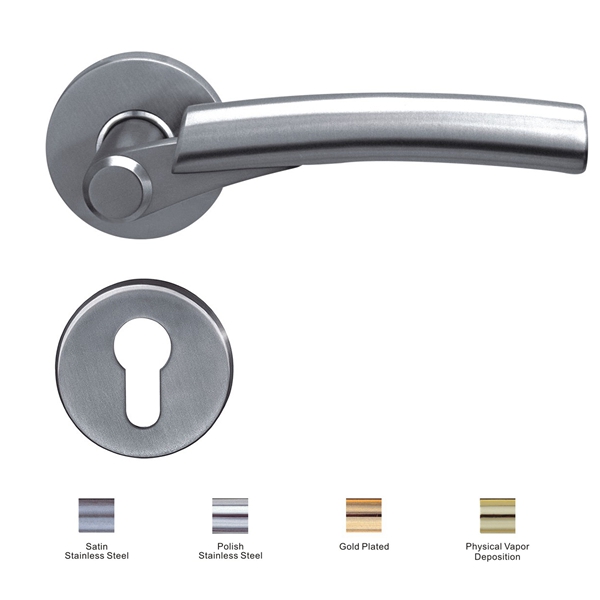
Door Handles are not measured with a single number. The correct handle set depends on a group of related dimensions, and missing just one can cause misalignment or rework.
The most important measurements usually include:
Door thickness
Determines spindle length, through-bolt length, and whether the handle set can clamp securely.
Backset
Distance from door edge to handle spindle centerline. It affects where the handle sits on the door face and must match the latch or lock.
Lock or latch type and dimensions
Tubular latch, mortise lock, multi-point lock, and profile cylinder systems each require different spindle positions and fixing methods.
Fixing centers or screw spacing
For lever-on-rose handles, screw holes are often concealed, but the underlying mounting pattern still matters. For lever-on-plate handles, the fixing centers may be defined by the plate and lock case.
Spindle size and shape
A common issue is ordering a handle set with the wrong spindle size or incompatible follower interface.
Handle projection and lever length
Determines clearance to the frame, wall, or adjacent hardware and affects comfort, accessibility, and safety.
Rose or plate dimensions
Controls whether the handle can cover existing marks, paint shadows, or old holes from previous hardware.
A reliable measurement process gathers these dimensions systematically instead of measuring only the visible lever.
You can measure most door-handle dimensions with basic tools, but accuracy improves with a consistent method and correct reference points.
Recommended tools:
Tape measure for general dimensions
Rigid ruler or caliper for spindle and screw spacing
Pencil and masking tape for marking centerlines
Screwdriver and Allen key to remove lever and rose covers
Flashlight to read lock faceplate markings
Setup tips:
Measure with the door open when removing hardware, but confirm latch-to-strike alignment with the door closed.
Use one unit system throughout, either millimeters or inches, and record it clearly.
Always measure to centerlines, not to edges of holes, to avoid systematic errors.
When replacing handles, your goal is to match existing door prep and lock compatibility. Measure first, then choose the handle set that fits the door, lock, and screw pattern.
Place the tape measure across the door edge from one face to the other. Record the thickness. This value affects spindle length and through-bolt reach.
Backset is the distance from the door edge to the center of the handle spindle. If the lever is installed:
Locate the spindle centerline, often visible by removing the lever or reading the lock case position.
Measure from the door edge plane to the spindle centerline.
Keep the tape perpendicular to the door edge to avoid an inflated reading.
Remove the latch or inspect the edge faceplate:
Tubular latch usually uses a round bore and a simple faceplate.
Mortise lock uses a rectangular lock case pocket.
Multi-point lock often has a long faceplate and several locking points.
Lock type determines whether you need a handle set with specific spindle interface and fixing method.
This step prevents the most common mismatch.
For lever-on-rose systems:
Remove the rose cover to expose the mounting plate.
Measure the distance between mounting screw centers if visible.
Note whether the handle uses through-bolts or wood screws.
For lever-on-plate systems:
Measure plate fixing points and the position of cylinder or thumbturn cutouts.
Record the handle-to-cylinder center distance if applicable.
Spindles are often square, and the most common sizes vary by market and lock type.
Remove the lever and measure the spindle across flat faces using a caliper.
Record spindle size and whether it is split spindle or full spindle if known.
Confirm whether the lock follower requires a specific spindle profile.
Lever length is measured from the center of the spindle to the end of the lever.
Projection is measured from the door face to the furthest point of the lever.
These two values affect clearance and usability, especially near frames or narrow corridors.
For new doors, measuring becomes specifying. The advantage is you can choose a handle and lock system that matches the project’s functional requirements and door design.
Key steps:
Decide lock type first
Latch, mortise lock, and multi-point systems define the handle interface, spindle position, and cylinder location. Handle selection should follow lock selection, not the other way around.
Define backset and handle position
Backset affects ergonomics and door stile strength. On narrow stile doors, the available backset may be limited by the stile width.
Confirm door thickness range
Ensure the chosen handle set supports the planned door thickness without special extensions.
Plan for accessibility and clearance
Lever length and projection should support comfortable grip and safe passage, while avoiding collision with walls, glass sidelites, or frame returns.
Confirm finishing and durability requirements
High-traffic doors, hospitality projects, and public buildings often require finishes that remain consistent under frequent cleaning and use.
When specifying a lever handle set for new doors, a structured measurement sheet reduces errors and speeds up procurement.
Most ordering problems come from a small set of repeated mistakes. Avoiding them saves time and prevents site rework.
Measuring to hole edges instead of centerlines
Always measure to the center. Errors compound when matching spindle and screw spacing.
Assuming all spindles are the same size
Spindle sizes vary. A handle that looks correct can be incompatible with the lock follower.
Ignoring the lock type and only measuring the handle
A handle is only one part of the system. Lock type determines spindle interface and fixing logic.
Not removing the rose cover to check mounting
Concealed fixings can hide important differences in mounting plate design.
Forgetting clearance at the frame
Lever projection can cause contact with the frame or wall, especially on narrow reveals.
Mixing units
Recording some dimensions in inches and others in millimeters creates avoidable ordering errors.
A good practice is to confirm key dimensions twice, using two reference checks where possible.
DESCOO provides lever handle solutions for architectural doors where consistent installation and long-term stability are important. Measurement accuracy is a major factor in achieving a clean fit, smooth operation, and reduced on-site adjustment time, especially in hospitality and construction projects.
Our service support typically includes:
Project-oriented selection guidance based on door type, usage intensity, and lock compatibility
OEM and customization service supported by a professional team
Measurement and installation guidance to reduce mismatched spindle and mounting issues
Problem-solving support for doors with existing prep constraints or special frame profiles
Solution-based supply aligned with real installation requirements and maintenance expectations
For reference to lever handle configurations and styles, visit: lever handle.
To measure door handles correctly, focus on the functional system rather than only the visible lever. Door thickness, backset, lock type, spindle size, and fixing method determine whether the handle will fit and operate smoothly. Lever length, projection, and rose dimensions then ensure clearance, comfort, and clean coverage of existing door marks.
A structured measurement checklist prevents the most common mismatches and makes supplier communication more efficient. When measurements are recorded clearly and matched to the correct lock and door conditions, lever handle replacement and new-door specification become straightforward, with fewer installation problems and more consistent long-term performance.