
Current door handle design is moving away from hardware that looks purely functional or completely uniform. Designers are paying more attention to the way a handle feels in the hand, how its finish works with wood and stone, and how it adds character to a room without becoming visually heavy.
In 2026, broader interior hardware trends are favoring warmer metal tones, patinated surfaces, softer shapes, and more visible craftsmanship. At the same time, simple stainless steel and nickel finishes remain practical for commercial spaces and interiors that need a cleaner appearance.
There is no single trend that suits every building. The most successful handle usually connects the door, interior materials, and expected use.
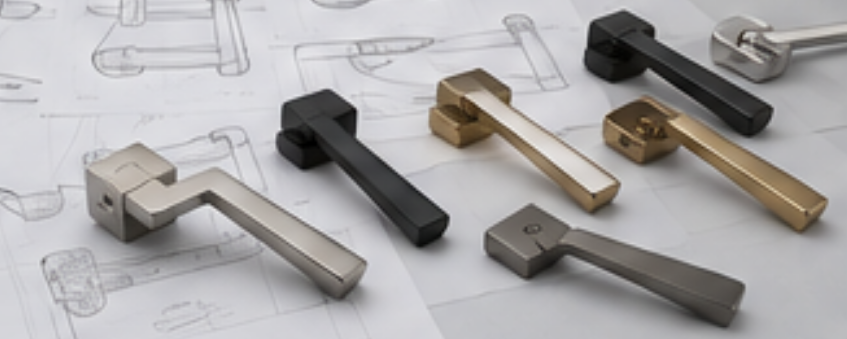
Brass is still widely used, but the current direction is broader than bright polished gold.
Popular warm finishes include:
Burnished brass
Aged brass
Dark bronze
Champagne bronze
Copper tones
Blackened metal
Soft antique finishes
These colors work well with oak, walnut, limestone, travertine, plaster, and warmer paint palettes.
Matte black has been widely used in modern interiors, but some projects are moving toward dark bronze and patinated finishes.
These finishes provide contrast while appearing softer and more layered than a uniform black coating.
They can suit both contemporary and traditional doors, especially where the interior includes natural materials.
A living finish changes gradually through touch, air, moisture, and cleaning.
Unlacquered brass, bronze, and copper may become darker or develop different tones in frequently handled areas.
Some designers value this natural change because each handle develops an individual appearance. Other projects require a more stable and consistent finish.
The specification should make the difference clear.
A living finish is expected to change. A plated, lacquered, or PVD finish is normally selected when the buyer wants greater color stability.
For hotels, apartments, and retail projects, maintenance expectations should be agreed before production so that natural patina is not later mistaken for a defect.
Modern lever handles are becoming softer in shape.
Instead of sharp rectangular sections, current designs may use:
Rounded lever ends
Gentle curves
Oval profiles
Tapered grips
Soft square roses
Smooth transitions between lever and neck
These forms can make the handle feel more comfortable while reducing an overly technical appearance.
A simple curve can still look modern when the proportions are controlled.
The finish is no longer limited to polished or brushed metal.
More collections now use:
Fine knurling
Linear grooves
Hammered effects
Sand-cast texture
Satin surfaces
Ribbed grips
Contrasting smooth and textured sections
Texture can improve visual interest and, in some designs, provide a more secure grip.
However, deep textures may collect more dust or cleaning residue, so the application should be considered.
Warm metals are receiving attention, but cool finishes have not disappeared.
Satin nickel, polished nickel, brushed stainless steel, and chrome continue to suit bathrooms, kitchens, offices, and commercial interiors.
These finishes work well with glass, light-colored doors, stainless steel fixtures, and modern sanitary products.
Brushed surfaces usually show fingerprints and minor handling marks less clearly than mirror-polished metal.
This makes them practical for frequently used doors, although the exact cleaning performance depends on the coating and surface direction.
Using one identical finish throughout an entire property is no longer the only approach.
A project may combine:
Bronze Door Handles with black hinges
Brass handles with polished nickel bathroom fixtures
Stainless steel handles with dark accessories
Warm hardware in guest rooms and cool hardware in service areas
The combination should still follow a clear rule.
Using two coordinated finishes normally looks more deliberate than introducing many unrelated colors.
Minimal door handles remain popular, but the current approach is less severe.
The design may still use a slim lever and concealed rose, while adding interest through better proportions, a warmer finish, or a small textural detail.
This creates a handle that is quiet enough for modern interiors but not completely generic.
Hotels, apartments, offices, and private-label brands increasingly want hardware that helps create a recognizable interior identity.
Customization may include:
Exclusive lever profile
Project finish
Custom rose
Engraved logo
Matching pull handle
Coordinated bathroom hardware
Special packaging
Market-specific spindle and lock preparation
The trend is therefore not only about appearance. It is also about creating a consistent hardware family.
Our lever handle range includes round-rose handles, contemporary levers, bathroom handles, passage handles, entrance handles, and interior-door models.
Selected products use solid 304 stainless steel and can be developed with brushed stainless steel, polished stainless steel, gold-tone, champagne, nickel, and PVD finishes depending on the model and project.
Our pull handle range also includes long handles, grooved designs, curved profiles, square sections, and products for residential and commercial doors.
Send us your preferred shape, rose or backplate, material, finish reference, door thickness, lock function, matching hardware, packaging, and quantity.
Our engineering team can modify an existing model or review a new design for a coordinated Modern Lever Door Handles collection.