
“Type A” and “Type B” are not universal door-handle categories with one fixed meaning across the hardware industry.
These labels are often created by an architect, door manufacturer, supplier, or project consultant to separate two handle specifications within a schedule.
In one project, Type A may mean a lever on a round rose and Type B may mean a lever on a long backplate. In another project, the labels may separate passage handles from locking handles or standard rooms from public areas.
The drawing and hardware schedule must therefore be checked before ordering.
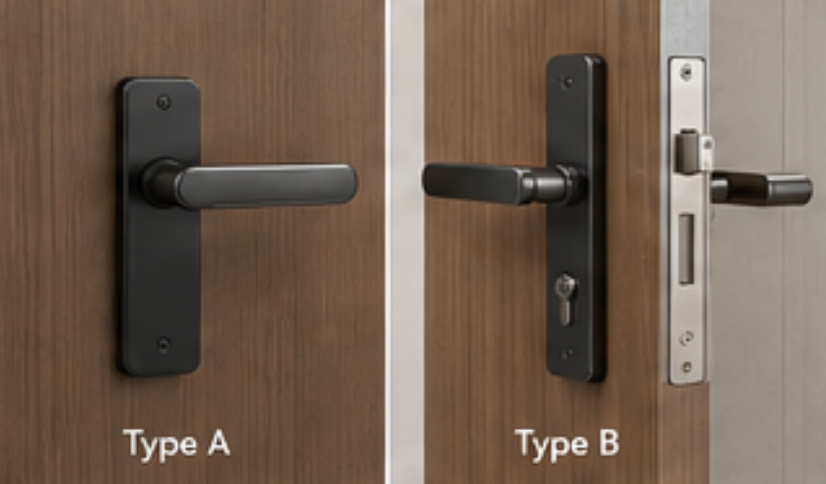
Common door handles are normally described by their structure or function, such as:
Lever on rose
Lever on backplate
Passage handle
Privacy handle
Entrance handle
Dummy handle
Sliding-door handle
Fire-door lever
Commercial lever
Type A and Type B do not provide enough information on their own.
The following example shows how a project might use the labels. It is not an industry standard.
| Project Label | Example Specification |
|---|---|
| Type A | Lever on round rose for passage doors |
| Type B | Lever on long backplate with keyhole |
| Typical use of Type A | Hallways, closets and general interiors |
| Typical use of Type B | Bedrooms, offices or controlled rooms |
| Locking function | None for Type A, keyed lock for Type B |
| Visual difference | Separate rose versus full backplate |
Another architect may define the same labels in a completely different way.
The labels may separate how the door operates.
A passage handle retracts the latch but does not lock.
It is commonly used for hallways, living rooms, and rooms where controlled access is unnecessary.
A privacy handle can be locked from inside, usually with a thumb turn or button.
It is generally used for bathrooms and bedrooms and may include an emergency-release feature outside.
An entrance handle works with a cylinder or another controlled locking mechanism.
It is used for doors that require authorized access.
A schedule may call these Type A, B, and C, but the project legend should define them.
Two handles can use the same lever shape but have different mounting plates.
The rose is a compact circular or square base behind the lever.
The key escutcheon or privacy turn is normally installed separately.
This creates a clean and minimal appearance.
A backplate combines the lever base and lock opening in one longer plate.
It may include a keyhole, cylinder opening, or bathroom turn.
Backplates can also cover existing door preparation more easily during renovation.
Type A and Type B may look almost identical while using different internal components.
Possible differences include:
Spindle size
Spring cassette
Fixing screw centers
Latch type
Mortise lock dimensions
Cylinder profile
Backset
Door-thickness range
Handing
Fire-door compatibility
This is why approving a product from a front-view image is risky.
A useful schedule should state:
Door number
Room location
Handle type
Lock function
Lock body
Cylinder
Backset
Door thickness
Finish
Quantity
The schedule may also include hinges, closers, door stops, flush bolts, seals, and emergency-exit hardware.
When a buyer asks for Type A or Type B handles, the supplier should request the drawing or specification sheet.
Important dimensions include:
Lever length
Projection
Rose or plate size
Fixing centers
Spindle section
Cylinder center
Handle-to-keyhole distance
Backset
Door thickness
Screw length
A project may use Type A for public areas and Type B for service rooms.
Type A could therefore use stainless steel with a premium finish, while Type B uses a simpler brushed finish.
Alternatively, one type may be specified for interior timber doors and the other for exterior metal doors.
The label should always be translated into measurable product requirements.
We manufacture lever handles, pull handles, hinges, concealed hinges, door accessories, and related hardware.
Our engineering team can compare the project schedule with an existing product range or modify a handle to match the required dimensions and function.
For Custom Door Handle Sets, we can review:
Lever profile
Rose or backplate
Material
Finish
Spindle
Spring structure
Latch or mortise lock
Cylinder preparation
Fixing screws
Packaging labels
Samples can then be marked clearly as Type A, Type B, or by the project’s own hardware code.
Send us the door schedule, elevations, handle drawings, lock-body dimensions, door thickness, function, finish, and quantities.
We will prepare a comparison sheet so that each custom door handle set is linked to the correct door location and installation requirement.